Ok, so you’ve started to plan your trip to Sri Lanka, but you’re now wondering “how do I actually get around once I’m there? Are you staring at a map of the teardrop shaped island? Getting lost in a rabbit hole of travel forums, debating whether to travel by tuk-tuk, train or hire a vehicle?
Getting around Sri Lanka can get confusing and chaotic to say the least, especially when you’re trying to decide how to get from point A to point B without being scammed, spend as little money as possible, while soaking up the adventure.
While public transport covers most of the country, there are some spots that aren’t covered and trying to plan your trip with Google maps will only get you so far.
There are a lot of moving pieces to really navigate the transport system in Sri Lanka.
We’ve been visiting Sri Lanka on an off for around 15 years and explored the country every which way.
We’ve travelled in style with an air-conditioned private vehicle and driver, to taking one of Sri Lanka’s most scenic train journeys and being crammed on a public bus to Dambulla for around 5 hours.
But rather than you having to do endless research on how to get around Sri Lanka, we’ve done all the legwork.
In this guide, we provide clear, honest and practical advice on navigating this beautiful country, without the stress.
We’ll breakdown all your options, from trains, buses, tuk-tuks, ride hailing apps, car hire and more. What works depending on each region and give you real tips to help you travel safely, affordably and confidently.
This post may contain affiliate links. Meaning that if you purchase through them, we may earn a small commission at no extra cost to you. This helps support our website and allows us to continue providing valuable content. We only recommend products and services we personally use and trust. Read our full disclaimer here.
What to know before you travel – Key things about Sri Lanka’s transportation network
Now before you start booking your train tickets, or jumping in a tuk-tuk, it’s worth understanding how the transport network connects to different cities, towns and villages around the country.
Because surprisingly enough, the road and transportation infrastructure is very good, while there are a very few spots that are remote and require a little planning.
The public transport system is a solid choice in most circumstances. If you’re visiting a large tourist city, such as Colombo, Kandy, Ella, Anuradhapura and beach destinations down south, then either the scenic train or bus is reliable and with new highways, this has significantly reduced travel times.
But outside the tourist routes, that’s where things are somewhat different.
In more rural or less trodden spots, options are limited.
In these circumstances, you may need to consider other alternatives, such as hiring a vehicle and driver, hiring a taxi or tuk-tuk, or you could hire a vehicle, tuk-tuk or motorbike and venture into the unknown on your own.
One thing we would advise from our experience, embrace it and be prepared to go out of your comfort zone. Adventures are there to be made.
Trains are often late, buses will stop unexpectedly, or your driver might take you to a hidden gem, that you weren’t expecting. Just go with the flow, as this is all part of the journey.
Pro tip: leave extra time for travel, especially if you need to catch your flight home.
Main transport options
OK, so you have looked on the map and seen that Sri Lanka is a tiny island, but don’t mistake its size for travel times, as you’ll be surprised how long you’ll be on the road for.
We have spent hours on the road, travelling from point A to point B, and let us tell you, it is long and tiring.
We can remember, going on trips when the highway wasn’t built and it took us hours to reach our destination. Thankfully the road network has had an overhaul over the years, including the time saving highways.
You don’t have to spend hours on the road, as we’ve broken down the most common ways to get around the island, so you can choose what works best for you, your budget, comfort level and that all important time factor.
Trains
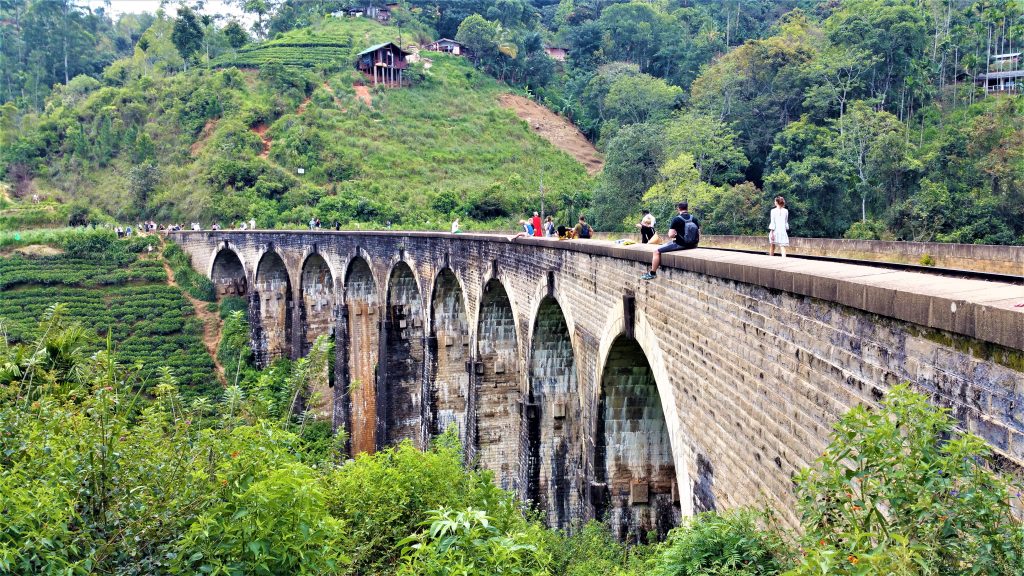
In our opinion, travelling by train on some of the most scenic routes is amazing. Look out at lush green tea plantations, and misty mountains or beautiful coastal views, heading down south to the beach destinations. BUT they are not always on time, and depending on the route, it can take time.
We took the train from Nuwara Eliya (Nanu Oya train station) to Colombo, which took us about 6-8 hours. We were grateful to be travelling in first class, as we had air-conditioning, comfortable seats and we would still sit and stand in the open doorway.
Needless to say, it was an adventure and one we would recommend.
So, which are the best routes to take by train?
Best for:
- Scenic journeys like Kandy to Ella/Nuwara Eliya, Nuwara Eliya to Haputale or Colombo to Galle
- Ideal for budget travellers and someone looking to travel like a local
- Ideal for flexible itineraries, when you’re not in a rush.
Not ideal for:
- If you are on a tight schedule, such as travelling back to the airport, as delays are common
- Travellers with large luggage or mobility issues.
Different classes available
- First class – these have reserved seats, air-conditioning, comfortable and relaxing vibe.
- Second class – large windows, no air-conditioning but fans to cool the air, reserves seats.
- Third class – cheap, packed and no guarantee of a seat, no air-conditioning or fans. Definitely the less comfortable option. We saw locals and tourists trying to pack themselves into a third-class train carriage at Kandy. So, it will be packed to the rafters to say the least.
Booking tips
Train tickets should be booked in advance, especially on the popular Kandy to Ella route. Tickets are available 30 days in advance.
If you don’t wish to book online, you can visit the train station and purchase the tickets over the counter.
You can purchase tickets online, or at the station.
Buses
Buses are the ultra-budget friendly option, but they are a little chaotic. If you want to feel like the fast and furious movie, then you’ll feel like you’re right in with the action.
We have taken a few buses over the years, and some are luxury with air-conditioning, while others are little uncomfortable.
But they are ideal for:
- Connections that the train doesn’t cover
- Hyper budget friendly either for short or longer journeys
- Definitely a wild experience, but you’ll be travelling with the locals.
Not ideal for:
- Luxury travellers
- Looking for comfortable journeys
- People with large backpacks or suitcases
Types of buses
- Government run buses – red in colour, normally slower, seem to stop everywhere, but dirt cheap
- Private buses – Blue or white. Their often faster, some have air-conditioning and a little more comfortable
Where to catch them from
- Major bus terminals in towns and cities
- Roadside, just hold out your hand to hail it, you don’t need to be at a designated bus stop, if it is heading in the direction you are travelling in.
Tuk-tuk
These are everywhere and probably the most common method to get around Sri Lanka for short distances.
We use a tuk-tuk all the time when travelling around Sri Lanka, they are iconic, noisy, but very efficient.
Best for:
- Short journeys, normally in cities or for sightseeing
- Day trips around ancient ruins, such as Anuradhapura and Polonnaruwa.
- Hiring a tuk-tuk and driving yourself
Not ideal for:
- Long distances, they can get expensive and uncomfortable
- Night rides, for safety reasons
Scams to watch out for
- Meter is broken – insist on using one or agree a price beforehand.
- Drivers insisting they can take you shopping for discounts, especially jewelry. Either decline their offer or decline riding with them. We have heard stories of tourists being locked in jewelry shops with pushy sales techniques, and the shop owner reluctant to let you leave until you purchase something. Don’t put yourself in that scary situation.
Pro tip – Agree on a price before accepting the ride, unless you have used a ridesharing app such as Uber or Pickme.

Taxi
Taxis are very much like a tuk-tuk, just a little more comfortable, and depending on the size of the vehicle, can be spacious too.
Best for:
- Longer distance travel
- If you are travelling with children or luggage
- Reaching remote areas that public transport doesn’t cover.
- Hail with a ride sharing app such as Uber or Pickme
Not ideal for:
- Ultra budget traveller
Private vehicle and driver
This is probably going to be the most convenient option. We have used this multiple times, when we take family and friends on a trip with us, to multiple destinations in Sri Lanka.
It’s way more comfortable, but more expensive. However, you’ll be surprised at how affordable it actually is.
Best for:
- Multiple stops
- Travelling with children, seniors or with lots of luggage
- Easy to reach remote areas that public transport doesn’t cover
Not ideal for:
- Ultra budget travellers
- Short inner-city hops, tuk-tuks or public transport is a better option
How to find reputable drivers
Your accommodation provider should have some good recommendations on private drivers and vehicles. They can often arrange it for you.
Facebook groups or TripAdvisor forums are another great spot to find reputable drivers.
Scooter, motorbike and tuk-tuk rentals
Are you an adventurous traveller? Then hiring a scooter, motorbike or even a tuk-tuk might be the right choice for you.
Hiring your own vehicle and driving, gives you the freedom, flexibility and the ability to travel at your own pace.
Best for:
- Hopping between destinations on your itinerary with ease
- Independent travellers looking for comfort on either two or three wheels
Not ideal for
- Large cities like Colombo, where traffic is chaotic
- Travellers without a proper driving license or insurance.
Legal requirements
- You’ll need a driving license that includes motorcycle endorsements
Road and safety tips
- Sri Lanka drive on the left-hand side of the road
- Watch for animals, especially elephants in the road, potholes and random speed bumps
- Always wear a helmet, even if the locals don’t
Transport costs in Sri Lanka
The great thing about Sri Lanka, is getting around doesn’t have to cost you an arm and a leg.
It’s very affordable, whether you choose to travel via public transport or private vehicle and driver. In fact, Sri Lanka is more budget-friendly than many countries across the globe.
To give you an idea of what budget you should set aside, we will break down the average cost depending on whether you travel via public transport or private vehicle, along with some money saving hacks and when it is worth splurging a little for comfort or experience.
Public transport
For travel by local buses, trains, tuk-tuk and short journeys by taxi you’re looking at just under $2.00 per day.
Sri Lanka Travel CostsPro tips
- Unreserved tickets are the cheapest option on the train, but are normally standing room only, depending on the route. The Kandy to Ella is a very popular route, so the chance of you getting a seat in 3rd class is very slim. If you want the comfort of a guaranteed seat, then book 2nd reserved, or 1st class in advance. Tickets online are available to purchase 30 days in advance.
- Always carry cash in small notes and coins, as change is rarely given. Card transactions on public transport are not widely accepted.
- You do not need to book in advance if you are travelling by bus.
- Use PickMe or Uber to book a ride and check rates. If you add your card payment to the app, you can pay for you rides with card. If not, we’d recommend paying by cash, as several drivers are reluctant to accept card payments or don’t have the card app.
- If you are hailing a tuk-tuk from the side of the road, always agree a fare before the ride starts, or ask for a meter.
- Mix and match transport, use trains for scenic routes, buses for budget travel and tuk-tuks for short hops
When to splurge
- Upgrade to 1st class on the popular Ella to Kandy route for stunning views and a more relax and comfortable ride.
- If you are taking a long 5+ hour bus ride, opt for an A/C intercity coach. You’ll thank yourself later.
- Long journey ahead of over 5+ hours? Or maybe needing to catch an early flight? Why not avoid the faff and hire a vehicle. This is our recommended option for comfort and convenience.
Private vehicle and driver
We’ve frequently used a private vehicle and driver for a few of our trips in Sri Lanka. We’ll often travel with Shams family or friends on short trips.
This is an ideal option if you want to travel in a little more comfort. Most vehicles will include air-conditioning and will take you from point A to point B and often to point C and D and so on, whether that’s for 1 day or multiple days.
This is ideal if you are travelling as part of a group, with family or even solo or as a couple.
The estimated cost per day is between $50-$80.
Pro tips
- Costs often include fuel and tolls but always confirm this upfront.
- In some instances, the costs will include the driver’s accommodation and meals. But clarify this upfront to avoid any unexpected costs.
From our experience, we’ve often paid for our driver’s accommodation and food, especially if they will be travelling with us for a couple of days.
And we’ll often invite them to sit with us during meals or for drinks.
Hire a scooter or motorbike
This is ideal for those who are looking for a bit of freedom, up for an adventure and happy to drive the chaotic roads in Sri Lanka.
How about hiring a tuk-tuk?
This is something that we would love to do but never had the confidence to drive ourselves on unfamiliar conditions.
If you are up for the challenge:
The estimated cost per day to hire a scooter is around $8.00
Pro tips
- Rent from reputable providers only, ask your guesthouse or hotel for recommendation. And always take photos of the bike before riding off and when you return the bike back.
You should now have an understanding of how much to set aside for a realistic budget on transportation costs, depending on what fits your comfort levels.
Safety, comfort and transport tips
Sri Lanka is a very warm, welcoming and friendly country and every time we have visited Sri Lanka, we have always felt safe.
BUT we can’t help but add that with every country, you still need to have a level of awareness and consideration for your own safety. Whether you’re on a packed bus, riding a train across tea plantations, or negotiating tuk-tuk’s.
We are about to tackle some of the common concerns female travellers have raised when visiting Sri Lanka along with our own realistic advice and experiences, to help you feel more confident and comfortable.
How safe is public transport
As mentioned above, public transport in Sri Lanka in general is safe, especially in terms of crime. Petty theft is rare, violent crime on transport is uncommon and Sri Lankans are incredibly helpful.
That said, safety concerns are either directly in connection with solo female travellers and about the road conditions and driving styles.
Things to watch out for:
- Reckless driving is common, especially with buses. We’ve experienced on several occasions, buses are overtaking other buses, with a third bus oncoming, all travelling at speed. Not only can this feel scary, but you may feel a little unsafe travelling on a bus.
- Overcrowded buses and trains can make the experience uncomfortable, especially if standing for hours before your stop.
- Night-time travel can be riskier due to poor lighting, stray dogs and fast vehicles.
Our tips on how to stay safe with public transport
If you are feeling uneasy, choose to travel during daytime, private vehicle or Uber and PickMe.
Trust your gut, if it doesn’t feel right, it probably isn’t, so skip it.
Female travellers
As female travellers, travelling together around Sri Lanka, our overall experience has been safe and positive.
Yet, we have always been conservative when travelling as a couple.
However, we’ve seen many solo female travellers on YouTube comment on how they have often attracted unwanted attention on public buses.
Now this is rare, but it does need to be said. Which makes it super important that your priority is your safety.
What may help
- Dress modestly – you shouldn’t need to change how you dress or behave, but when cultures are different to our own, we should adapt and in this case wear modest clothing, especially while travelling on public transport. Covering the shoulder and knees will go a long way towards reducing unwanted attention, especially from males. Needless to say, this in some cases haven’t deterred men from approaching females inappropriately.
- Sit near women and families – Sitting with another female or with families, may help to deter unwanted attention and help ease any fears you may have.
- Avoid late night public transport, especially if it is poorly lit or sparsely used.
Most locals are friendly and respectful. You may get some questions, but these are rarely threatening, they are just culturally different. For example, I get asked all the time if I am married. I politely say no and try to avoid any further questions of that nature.
Most of the time, if you are firm but politely say no, then you’ll get left alone.
Travelling with luggage
You’re likely to be travelling around Sri Lanka with a large suitcase or backpack. If this is you, then you’ll need to consider the best transport options, to avoid unnecessary problems or stress.
Most public transport options have limited luggage space. On a train, you may find space near the door, but it won’t be secure.
Buses don’t have under the bus storage, if you have a large bag, this is likely to be held close to the driver’s seat.
When we travelled by train in first class, luggage space wasn’t a problem, but in lower classes, where space is tighter, it is likely to be more challenging.
While on the intercity bus we took from Colombo to Dambulla, we took a small cabin bag with us, which was kept at the front by the driver, due to limited space.
Tuk-tuks are super compact with limited space. Depending on your party size, you may not be able to fit you and your bag with you, unless you are travelling solo.
Travelling by private vehicle is somewhat less stressful, with plenty of bag space. In most cases, there is some boot space to place your suitcases and backpacks.
Although word of warning. The small compact cars that you book from Uber, are unlikely to have large boot spaces, such as the Suzuki Alto.
We would recommend ordering a medium size vehicle, when travelling long distances with luggage.
You should weigh up, which is the best transport method for you.
Essential travel apps and resources
Having the right apps and resources from the outset is a real game changer.
The apps will help you to book trains, hail rides, check routes, and just getting data while on the go.
These are the tools that we simply can’t live without in Sri Lanka.
PickMe and Uber
These are our go to apps, if we don’t want to haggle over tuk-tuk prices or trying to flag a tuk-tuk in the road.
While in the apps, you can watch in real time, where your driver is and how far away they are from the pick-up point.
You’ll see the price upfront, so you won’t be surprised by any hidden charges.
Plus, you can choose between a tuk-tuk, small vehicle, medium size vehicle or a premium vehicle.
Pro tip – try to avoid travel during peak rush hour or during a large celebration such as Vesak in May. Vehicles are usually limited or not available during these times.
Conclusion
There is one key takeaway from getting around Sri Lanka, it’s being flexible.
You don’t need to pick just one way of travelling, unless that really suits you. Why not try a variety of options, from public transport and hiring a driver.
We’ve travelled by bus, train, tuk-tuk and with a private vehicle, all have its pros and cons.
We loved the experience of taking the train from Nuwara Eliya to Colombo, while it was a long journey, we loved standing in the open doorways, watching the scenery slowly pass us by.
Travelling by bus on a day trip to Galle from Colombo, was also a comfortable journey. Compared to the local bus to Dambulla was somewhat more cramped, with small black ants crawling across the seats.
In our opinion, travelling by private vehicle must be the most comfortable, relaxed and less stressful way of exploring the country. And while it is a little more expensive, it is definitely worth it, when you don’t need to stress about luggage space and navigating public transport.
Depending on your itinerary and how much time you have in Sri Lanka, we would recommend taking a tuk-tuk and bus for short journeys, and taking the train from either Colombo, Kandy to Ella and Nuwara Eliya.
Any other long-distance trips might be worth hiring a vehicle.
However, there is no one size fits all here, as it will depend on your budget and travel style.
Have questions about planning your route, concerns about safety, or want our honest take on a specific route? Pop your thoughts in the comments—we’re always happy to help.
And if you’ve already visited, we’d love to hear how you got around—every story helps other travellers just like you.
Continue your travel planning, with these useful posts:
- Things to do in Polonnaruwa
- Best places to visit in Anuradhapura
- How to climb Sigiriya Rock
- 10 Common Sri Lanka travel mistakes and how to avoid them
- How to climb Pidurangala Rock
- Best National Parks in Sri Lanka
- 2 Week Sri Lanka itinerary
- Best places to visit in Sri Lanka
- Tips you must know before visiting Sri Lanka
- How to visit Yala National Park on safari


