Visiting Anuradhapura is like stepping back in time. It’s where ancient stone stupas pierce the sky, and history hums beneath your feet. That’s the exact feeling you’ll get as you wander the sacred city of Anuradhapura.
It’s one of the most spiritually rich and historically significant places in Sri Lanka.
So, if you’re looking for unforgettable places to visit in Anuradhapura, whether it’s your first time or you’re craving something deeper than the usual tourist stops, then you’re in for something special.
We spent a full day exploring the temple ruins, the ancient capital and just getting lost among the ancient dagobas and soaking up the spiritual energy that’s been left here after thousands of years.
Anuradhapura is a blend of culture, history and a sense of timeless wonder.
If you’re asking any of these questions:
Do I need a guide? How do you get around such a vast ancient city? Where are the absolute must-sees if you’ve only got one day?
Don’t worry, we’ll cover all of that in this no fluff guide.
We will help you make the most of your visit, so you can feel confident and connect deeply with one of Sri Lanka’s most sacred and awe-inspiring destinations.
Are you ready to uncover the ancient wonders of Anuradhapura?
This post may contain affiliate links. Meaning that if you purchase through them, we may earn a small commission at no extra cost to you. This helps support our website and allows us to continue providing valuable content. We only recommend products and services we personally use and trust. Read our full disclaimer here.
Best things to do in Anuradhapura
Sri Lanka might be a small island, but its once capital is pretty big. It would take you a few days just to wander around the sprawling ruins, soaking up its spiritual energy.
But we realise you don’t have days, so we have narrowed it down to these essential places to visit in Anuradhapura, that’s a mix of iconic landmarks to lesser-known gems.
Visiting the Sacred Bodhi Tree (Sri Maha Bodhi)
Now this is no ordinary tree! This is known to be the oldest in Sri Lanka at over 2,000 years old.
A cutting from the original Bodhi tree from Bodhgaya in India was planted and has been tended to ever since by guardians.
What is so significant about the tree, is that it is where Buddha gained enlightenment.
Pilgrims visit daily, to give offerings and prayers.
On our visit to the Bodhi Tree, we spent a while here, soaking up the peaceful atmosphere, taking some time to reflect and pray.
Before too long, it became overcast, and the rain started to pour, and we had to run for cover.
Sadly, this brought a halt to further exploration of Anuradhapura for a while, as the area soon flooded and we had to wade through ankle deep water, to find our shoes and private vehicle, to dry off.
When it doesn’t rain, this is a great spot to soak up the culture and religion. Take in the peaceful atmosphere, pray and get involved with the traditions by offering flowers.
Ruwanwelisaya Stupa
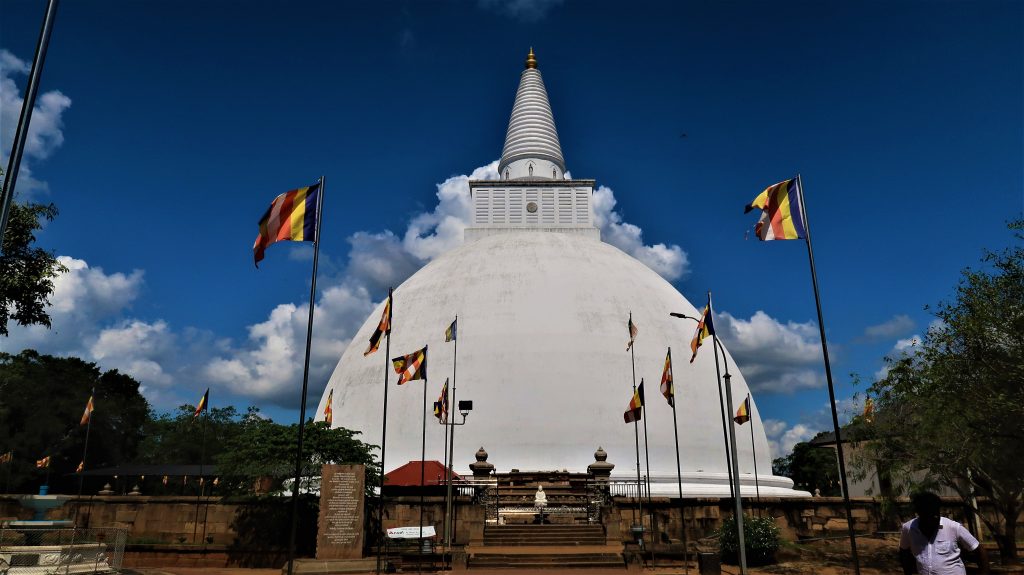
Just a short distance from Sri Maha Bodhi is the Ruwanwelisaya Stupa.
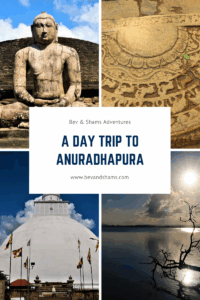
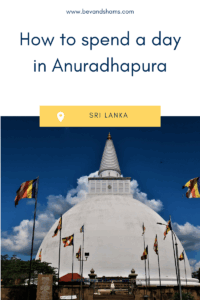
This large white Stupa dominates the skyline, with a height of around 55m.
The original structure was built around 2,000 years ago at a considerably taller height, but due to damage from invading Indians, it was reconstructed to what we see today.
Walk the full perimeter barefoot, to really connect with something special and ancient.
The land around the Stupa is dotted with ponds, pools and a collection of columns and pillars.
Jetavanarama Dagoba
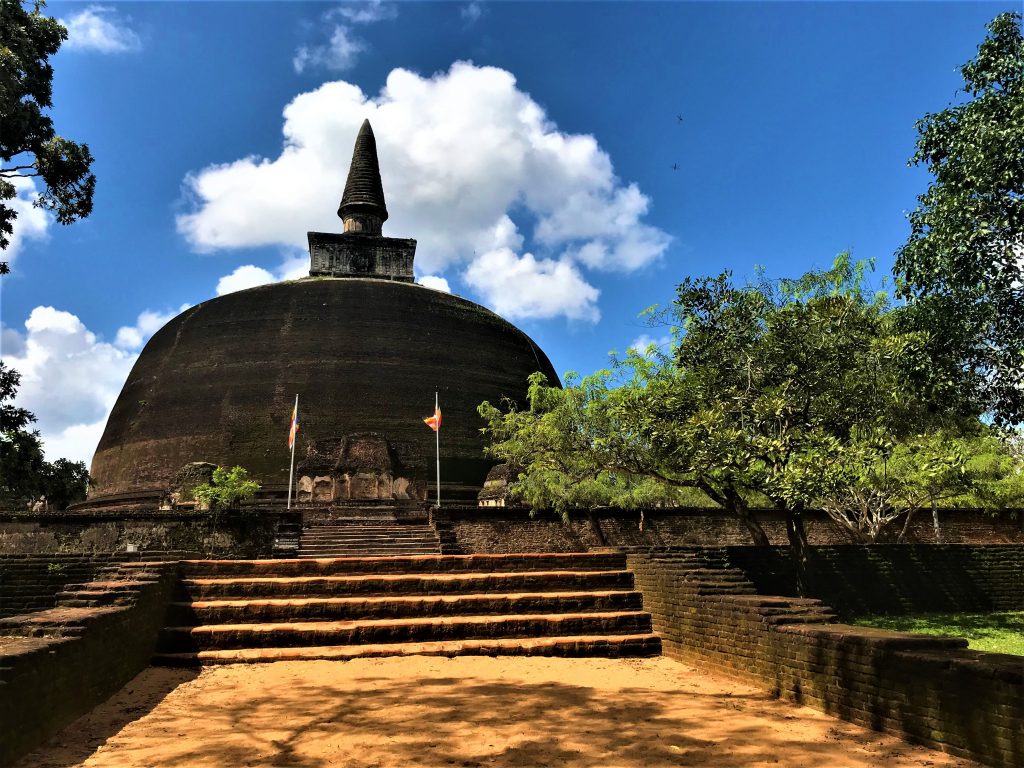
This is far less crowded and touristy than Ruvanvelisaya Dagoba, but it was once the third largest structures in the ancient world, surpassed by only by the Pyramids of Gaza.
The surrounding area leaves behind ruins of an old monastery that would have housed around 3000 monks.
The stupas appearance is somewhat a sleeping giant, its weather-worn surface radiates centuries of quiet endurance.
Lowamahapaya
What is left is around 1600 columns, this structure would have once formed a huge pavilion with a bronze-tiled roof.
It would have accommodated around 1,000 monks and would have been around nine storeys tall.
Over the years it was rebuilt but less grand as its previous construction.
Thuparama Dagoba
Thuparama Dagoba is the oldest dagoba in Sri Lanka and possibly the oldest in the world.
It is said to enshrine the right collarbone of Buddha.
Jetavanarama Museum
Not quite the fitting you’d get in an ancient city, but this British Colonial building, adds a little difference to the area.
Inside the museum, you’ll find all manors of objects from finely carved ivory to the rediculous ancient toilet pipes.
The highlights in room 1 are the elaborately carved urinals and in room 2 is a tiny decoration featuring eight exquisite flowers.
Archaeological museum
Another British Colonial building that is home to a collection of artwork, carvings, and everyday items from Anuradhapura and sites around Sri Lanka.
One exhibit is a restored relic chamber, that was found during an excavation of the Kantaka Chetiya Dagoba.
Best way to visit Anuradhapura
Now, one of the best ways to get around Anuradhapura is with pedal power, just due to the distances between some of the sites.
It’s also the perfect balance between having your own freedom, travelling at your own speed, detour down quiet lanes, and stumble upon lesser-visited ruins.
If you are looking to visit Anuradhapura on two wheels, you can rent a bike from the local stores in Anuradhapura, from your accommodation or from Bikesbooking.com.
Unless you are living in Sri Lanka, or staying for 3 months plus, then you’re likely to be limited on time. So, walking will take some time.
If you do choose to walk between the different sites, you might want to just prioritise the most important things you want to see, or stay in one defined area, that way you can make the most of what you experience.
Another option is to hire either a tuk-tuk and driver, to guide you between sites, or a private guide with a vehicle.
From our experience, this felt a little rushed. We hired a tuk-tuk in Polonnaruwa, to take us to the various sites we wanted to see, but it didn’t have the same authentic feel as hiring a bike may have been.
For us the main concern which put us off, was cycling between each destination with the hot Sri Lankan heat. Plus, Shams was more concerned about being in the sun.
You should decide which option is more suitable for you and your needs. But in our opinion cycling is something to consider.
Practical travel tips for Anuradhapura
The city is vast, the ruins are spread out, and getting around can be a bit confusing if you don’t do your research.
But we have some good news! You don’t need to look far to find all the information. Here is everything you need to know to help you plan your epic adventures in Anuradhapura.
Getting to Anuradhapura
Anuradhapura is located north of Dambulla, but it is well connected and easy to get to.
Public transport
By far the cheapest option and best suited for budget travellers, looking to spend as little money.
You can take the bus or train.
The train will be more comfortable and offers scenic views along the route.
If you’re travelling by train, make sure you book in advance, especially if you want to reserve seats.
Trains run from Colombo or Jaffna.
Buses on the other hand run from Colombo, Dambulla, Kandy, Jaffna, Mihintale and Polonnaruwa.
Buses run regularly, they’re cheaper but uncomfortable, hot and crowded.
You may find it more challenging, travelling by bus if you have large luggage.
You can check out rates and availability with Rome2Rio.
Private driver
This is an expensive option, but the most convenient and flexible way to get to Anuradhapura.
This option would be suitable for couples or groups.
You can be flexible with the stops and really define your Sri Lanka itinerary.
Self-drive
It takes confidence to drive in Sri Lanka, but if you’re up for the challenge, then you could hire a car, motorbike or even tuk-tuk to take you around the island.
We haven’t been confident to drive due to the chaotic driving styles.
Pro tip: If you’re arriving by train, tuk-tuks are usually waiting outside to take you to your hotel or straight to the ruins.
Entrance fees
To access the main historical sites, you’ll need a ticket, which can be purchased from the main Archaeological Office.
Single entry tickets cost $30.00 per adult and $15.00 per child.
What to wear
As many of the sites in Anuradhapura are sacred, especially temples and stupas, it is important to wear modest clothing, this is about being respectful of other religions and beliefs.
You should cover your shoulders and knees. Long dresses, skirts or comfortable trousers are suitable, along with a top that covers the shoulders.
If you don’t have anything that will cover your knees or shoulders, then a sarong and scarf will be ideal.
In some places, shoes must be removed before entering. Bring socks to wear, as this will help with walking across the burning hot stones.
Pro tip: White is considered a holy colour in Sri Lanka, when making a pilgrimage to sacred sites. You may wish to adopt this out of respect.
Need more tips on what to expect and how to be respectful when visiting temples and sacred sites? Then check out our guide on what not to do in temples and places of worship.
Where to stay in Anuradhapura
Taking a day trip to Anuradhapura is possible, but might be a little rushed and you may find that you can’t fit everything in.
Spending at least one night, will give you some flexibility to cover anything you couldn’t from the day before.
If you’re including at least one night or more into your itinerary, then these are our recommendations on places to stay.
We have picked a variety of budget friendly to luxury accommodation.
Pro tip: Book accommodation with free bike hire if possible—it’ll save you time and money!

Suggested Anuradhapura itinerary
We have created a couple of suggested itineraries for Anuradhapura depending on how long you have here.
1 day in Anuradhapura
If you are short on time and only have a day to spend in Anuradhapura, then you should prioritise the most important sites that you’ll want to visit.
Here is a suggested itinerary for just one day:
Stick with the highlights
Start at Sri Maha Bodhi Tree, spend a short time here, before either walking or cycling to Lovamahapaya, which is just a short distance away.
The next stop is Ruwanwelisaya Stupa, before making your way to the last spot, which is Jetavanarama Dagoba.
2-3 days in Anuradhapura
If you have some extra time and like to slow travel around Sri Lanka, then we would recommend spending a minimum of two days in Anuradhapura, but you can spend three days if time permits.
This is our suggested two-to-three-day itinerary:
By following this itinerary, this allows you to spend more time at each site and really soak up the atmosphere.
Start day one at the Archaeological Museum, admire the collection of art, carvings and learn more about the ancient city of Anuradhapura.
Now make your way to Sri Maha Bodhi Tree, spend some time on reflecting, giving offerings and praying.
The next stop on day one is the Lovamahapaya, before heading off to Ruvanvelisaya Dagoba.
This brings you to the end of day one, return to your accommodation for rest, ready for the next day.
Day 2 in Anuradhapura
Start day two at Jetavanarama Museum, learn more about the range of objects on display here, before making your way to Jetavanarama Dagoba.
The last stop on day two is Thuparama Dagoba.
If you didn’t have time to visit some of the sites in day one, then cover these off in day two, before taking the rest of the afternoon to relax and continue onto your next destination in Sri Lanka.
Conclusion
Now this isn’t your typical tourist spot in Sri Lanka, it’s not flashy, but there is something rare here. It’s a chance for you to connect with history, spirituality and a slower more meaningful kind of travel.
If this sounds idyllic, then trust us you must include Anuradhapura to your bucket list destination in Sri Lanka.
We can still remember, taking in the peaceful tranquility at Sri Maha Bodhi Tree, before the rain came. This was the time for reflection, giving offerings and a chance to pray.
This is the kind of experience that stays with you long after you’ve unpacked your bags.
Planning a visit? Got questions? Drop them in the comments, we’re happy to help!
Whether you’re mapping out your Cultural Triangle route or trying to figure out if one day is enough, we’d love to chat with you about it.
Continue your travel planning, with these useful posts:
- What to pack for a safari
- How to climb Sigiriya Rock
- Common Sri Lanka travel mistakes and how to avoid them
- How to climb Pidurangala Rock
- Best National Parks in Sri Lanka
- Best train journeys in Sri Lanka
- 7 Day Sri Lanka itinerary
- 2 Week Sri Lanka itinerary
- 10 Day Sri Lanka itinerary
- Tip on how to visit Sri Lanka – everything you need to know