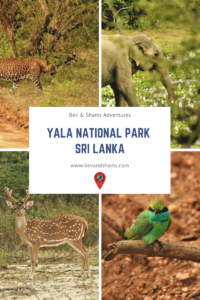
If you’ve been planning to visit Yala National Park on safari, the biggest challenge isn’t just about whether it’s worth visiting, it’s also about figuring out the best way to do it without wasting time, overpaying, or ending up on an overcrowded game drive.
Yala National Park is the most famous and popular national park in Sri Lanka, for good reason, so planning it can feel a little challenging, especially when you’re faced with different safari options and dozens of tour operators all claiming to offer the best experience.
Having visited Sri Lanka for over 15 years, and experienced our first safari at Yala National Park, we know how important it is to plan the trip, from visiting at the right time, choosing where to stay, which safari option is best and what to pack, including binoculars.
In this guide, we cover exactly how to visit Yala National Park, including the best time to go, how to book your ideal safari, where to stay, what wildlife you can realistically expect to see and what to pack for first-time visitors.
By the end, you’ll have everything you need to visit Yala National Park independently, that fits your schedule, budget and travel style.
This article may contain affiliate links. Using these links will not cost you anything extra, but we may earn a small commission. Thank you for your support.
Is Yala National Park Worth Visiting?
Yala National Park is not the only park in Sri Lanka, but it is the most popular. So the questions are, is Yala worth visiting? And is it the right park for you?
Best for:
- Leopard sightings
- First-time safari experiences
- Wildlife lovers
- Photographers
Not ideal for:
- Travellers wanting a quiet safari
- People who dislike long dusty drives
- Ultra-budget travellers
- Those expecting guaranteed sightings
Recommended safari:
- Full-day safari for the best experience
- Stay 1–3 nights in Tissamaharama.
Typical cost:
- $60–$150+ depending on safari type
Best months:
- February–June

Best time to visit
Sri Lanka has two main monsoon seasons a year, which impact different regions and therefore will affect the wildlife sightings and your experience.
The Maha monsoon is between October and January and affects the northern and eastern regions, while the Yala monsoon is between May and August, which affects the southern and western areas of Sri Lanka.
The best time to visit Yala is during the dry season between February and July, when wildlife gathers around shrinking water sources.
Peak season also means more jeeps and busier safari routes.
Travel during the wet season (September to January) is less crowded, with fewer jeeps, but wildlife spotting can be less predictable.
If you are a birdwatcher, this is the perfect time to visit; you’ll see lush green landscape and dramatic skies, making this the perfect environment for photographers.
It’s far cooler, with temperatures ranging from 25 – 30°C.
So, when should you go?
If your main purpose of visiting Yala National Park is for wildlife, then aim for between February and June.
Yes, it is busier, but this is when animals will gather around water sources, which increases the chances of seeing different species of wildlife.
If you prefer fewer crowds and a reduced chance of sighting certain animals, then the quieter months are fine, especially if you’re more into photography, birds or landscapes.
Pro tip: Binoculars are essential for wildlife spotting. We really wish we’d brought ours. We could have seen the leopards lazing in the distant trees.

Yala National Park opening times
Yala National Park opens daily between 6:00 a.m. and 6:00 p.m., providing visitors with the opportunity to explore the park during cooler hours.
When is the best time of day for a safari?
Yala offers morning, afternoon, and full-day safaris depending on your budget, schedule, and wildlife goals.
Morning safari
This is an ideal time to visit Yala National Park, as the temperatures are cooler and before any animals retreat into the shade.
Morning light also makes this the best time for photography, as the light is much softer.
Afternoon safari
Afternoon safaris are a great time, especially later in the day as the temperatures drop a little.
Sunset is one of the best times to be there, when everything turns a beautiful golden colour.
Full-day safari
You get the best of both.
How to get to Yala National Park
Yala National Park is located in the southern regions of Sri Lanka, and because it is quite remote, getting there takes some planning.
Most travellers visit Yala from Colombo, Ella, or Sri Lanka’s south coast. If you wish to follow the same route, these are the easiest ways to navigate:
Colombo to Yala National Park
Public transport from Colombo takes 6–9 hours and is the cheapest way to reach Yala. The closest stop to Yala is Tissamaharama. This is a more affordable option than a private driver.
A private driver will take around 4-6 hours, depending on traffic, but it is more expensive.
South coast to Yala
Public transport is available up to Tissamaharama, with a journey time of around 3-6 hours. A private driver usually takes 2–4 hours.
Ella to Yala
Buses are the only public transport option, but you’ll need to take a connection in Wellawaya, before taking the bus to the closest town of Tissamaharama, from there take a tuk-tuk or take a taxi to the entrance. Journey times will be around 5-7 hours.
Alternatively, take a private driver directly to the entrance, with a journey time of around 2.5-4 hours.
Need help with planning your trip to Sri Lanka and creating a travel itinerary, that fits your interests?
The Sri Lanka pocket guide, will help answer the most common questions we see come up, will help you plan your trip and a free 14 day itinerary, that’s been made for first time visitors. Let’s plan your trip together independently.
Our recommendation
If your budget allows, hiring a private driver is the easiest and least stressful option.
Public transport can be more exhausting, and that’s even before going on safari.
Most travellers will stay at least one night in Tissamaharama, which is a great base for visiting Yala National Park.
Half-Day vs Full-Day Yala Safari: Which Should You Choose?
OK, so choosing the right safari is going to come down to three things:
- Your budget
- Your time
- Your wildlife goals
But which do you choose?
Half-day vs full-day safari
There are two choices: a full-day or a half-day visit. But which is right for you?
A half-day safari is ideal for first-time visitors, travellers with limited time, casual wildlife enthusiasts and those looking for a less tiring experience.
Typically, a half-day Yala National Park jeep safari will last between 3 and 5 hours and give you a real Sri Lanka safari experience through rugged terrain.
A full-day safari can start from sunrise to sunset, with a midday break for lunch.
We stopped by a river in Yala to dig into our packed rice and curry. It had been wrapped so snugly that it was still lovely and warm by the time we ate.
We had a beautiful setting, sharing our lunch with friends beside us.
With a full day on safari, you do have an increased chance of seeing a wide range of animals.
If you’re a serious wildlife lover, a photographer, or just someone wanting a fully immersive safari, a full-day tour is your best bet.
A full-day safari can definitely feel exhausting.

Private vs group safari
You can also choose between a private or group safari.
Choosing which will depend on your travel style.
A private safari offers a more personalised experience, where you can choose your own schedule and focus on specific wildlife, yet this will be more expensive.
A private tour will better suit couples, families and serious wildlife photographers.
On the other hand, a group safari is a more budget-friendly option, and it can be a more social experience.
You’ll share the jeep with between 4-6 other travellers, but you’ll have less control over where you stop, how long you spend at each stop and what wildlife you may want to spend more time with.
A group safari is suitable for solo travellers, budget-conscious travellers and those looking to meet like-minded travellers.
What nobody tells you about going on safari in Yala National Park
Going on a safari in Yala National Park was one of the highlights of our trip to Sri Lanka.
However, there were some things we wish we had known beforehand, especially since this was our first safari adventure.
Safaris can be physically tiring.
Whether you take a full or half-day safari, the experience can be tiring.
The day starts early, normally rising around 4:30 to be ready to enter the gates as soon as they open.
The dusty roads, heat, and constant driving can feel surprisingly exhausting by the end of the day.
When we come to do another safari, we’d stay at least 2 nights instead of the one. It wouldn’t have felt like a rush.
Having time to rest before and after the safari would have made the experience far more enjoyable.
You may spend more time driving than spotting animals.
You may find yourself spending long periods driving without seeing much wildlife, which is completely normal.
Let’s be honest, Yala is a safari and not a zoo.
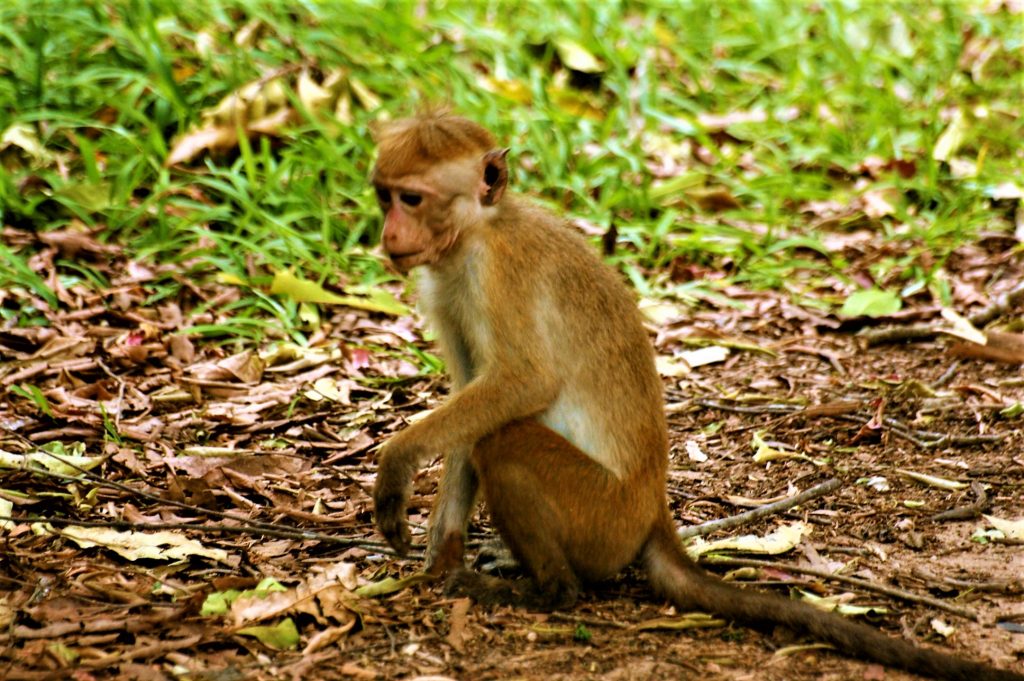
We saw plenty of animals on our safari, including birds, deer, monkeys, and elephants, but some animals stayed well hidden throughout the day, including the sloth bear.
The best approach is to stay patient and enjoy the overall experience.
How to book a safari at Yala National Park
When it comes to booking a safari to Yala National Park, you should book your tickets with reputable companies to avoid any scams.
The two main options are via your accommodation provider or with a reputable tour operator.
Most big hotels and lodges that cater to tourists can help you set up a Yala safari. Just enquire at reception, and they’ll either arrange it for you or give you the right contacts.
A typical booking covers the jeep and driver, park entrance fees, and sometimes a guide. In most cases, it’ll also include pick-up and drop-off from your hotel.
Hotels can charge more for safari bookings, so if you want to save a bit, it might be worth going through an independent tour company instead.
However, not all independent tour companies offer the same experience.
Some drivers focus on responsible wildlife viewing, while others prioritise chasing sightings as quickly as possible.
Before booking, always check recent reviews carefully and look for comments about:
- Respectful driver behaviour
- Safe distances from wildlife
- Punctual pick-up times
- Knowledgeable guides
- Smaller or less crowded jeeps
Avoid operators that:
- Overcrowd jeeps
- Drive aggressively through the park.
- Get dangerously close to animals
- Chase wildlife for photographs
- Pressure animals for better sightings
One of the biggest red flags for us is when drivers surround the animal.
Not only will this create a stressful environment for the wildlife, but it can also ruin the experience for visitors.
If possible, ask operators:
- How many passengers share each jeep
- Whether park fees are included
- Whether binoculars are provided
- How long does the safari last
- Whether they follow responsible wildlife viewing practices
A good safari should feel respectful, calm, and patient, not rushed or chaotic.
During our own safari experience, one driver offered to get us much closer to an elephant for photography, but we didn’t realise how close he actually meant.
Instead of a lovely picture of an elephant grazing in the short distance, we had an animal that was visibly uncomfortable and distressed. We asked the driver to back away immediately.
Experiences like this are why choosing a responsible safari operator really matters.
Pro tip: One of the best Yala safari booking tips is to choose a knowledgeable guide who knows where to find the wildlife.


How Much Does a Safari Cost?
Yala National Park fees can vary depending on the block you visit, the tour operator and whether you’ll be sharing a jeep or hiring one privately.
Not all blocks are open to tourists, though.
For a half-day safari, you can expect to pay around $30-$50 per jeep and about $30 per person in park fees.
You can expect to pay around $85–$100 per jeep for a full-day safari, plus the park fees per person.
When we did our safari, we were travelling with some close friends from Sri Lanka, so we had a private jeep for our travelling companions and us.
If you’re travelling as a family or group, you can split the cost of using one jeep between the group.
Budgeting tips
We’d always recommend paying the driver a tip, especially if you enjoyed the safari. We’d recommend tipping around $5–$10, depending on the level of service.
Make sure you factor this into your budget.
Make sure to do your homework before booking and double-check that the park fees are covered in the price. The worst thing to happen is that you’re surprised by additional costs you hadn’t factored in beforehand.
Some companies include free pick-up and drop-off. Definitely use it if the company is reliable and reputable.
Not all meals are included within the reservation. Check for an affordable option with meals included, or ask your accommodation to pack a lunch for you to take on the safari.
The most affordable option is to make your own meal. Think sandwiches, pasta, or homemade snacks, something that’ll survive the heat in the jeep and keep you fueled throughout the safari.
Yala is a hit with tourists and locals, so make sure to book in advance; you don’t want to be left disappointed.
Staying near the park entrance makes early safari starts much easier.
Sri Lanka Travel CostsWhat to pack for a safari
If you want a comfortable safari experience, without missing anything, then you need to pack these:
Essential gear for a Yala safari
If you want to document your experience and take some incredible pictures of wildlife, then this essential gear must be packed:
- Binoculars – We didn’t have binoculars on our trip, and we really wish we had some. Wildlife should be viewed from a distance. Binoculars are great; they let you get up close to the wildlife while keeping to a safe distance.
- A camera and a zoom lens – You don’t need a top-of-the-range camera, but make sure it’s decent and allows you to swap lenses. A DSLR is fantastic, but a mirrorless camera or your smartphone will be sufficient. The best lens is with a range of 200-400mm. This is ideal for wildlife photography.
- Hat and sunglasses – The sun gets intense, particularly at midday. To protect your eyes and face, a wide-brimmed hat and UV-protection sunglasses are highly recommended.
- Sunscreen – Don’t forget SPF 30+ sunscreen, the sun in Sri Lanka is no joke!
- Neutral clothes – You’ll want to blend in as much as possible; beige, brown, khaki, or green are perfect for not standing out.
- Scarf or buff – It gets extremely windy and dusty as you whiz through Yala National Park, a scarf or buff to cover your nose and mouth will protect you from inhaling the dust and dirt. We didn’t protect our faces, and the dust and dirt got into my lungs, so I had a cough for about a week afterwards.
- Reusable water bottle – Staying hydrated is crucial. Bring a reusable water bottle; it’s perfect for keeping you hydrated while out exploring.
If you need a more comprehensive guide on what to pack and what to leave at home, then check out our guide on what to pack for a safari.
You can also download our free packing checklist, so you won’t miss a thing, and you’ll stay organised on every trip.

Planning a Bigger Sri Lanka Trip?
If you’re still planning your Sri Lanka itinerary, transport, budget, or route, our Sri Lanka Pocket Guide can help make the process much easier.
It includes:
- a beginner-friendly 14-day itinerary
- practical travel tips
- budgeting advice
- answers to common first-time visitor questions
It’s designed for independent travellers who want to plan their trip confidently without relying on expensive tours.
Where to stay near Yala National Park
There are different accommodation options depending on your travel style.
You could stay in a hostel, which is affordable and clean. To book a hostel, check out Hostel World and find your best deal.
If you are looking for somewhere that offers your own personal space and a private bathroom, then a mid-range or luxury accommodation could be right for you.
The best area to stay is around Tissamaharama. It’s the closest village to the park and an ideal spot to unwind. Alternatively, you could stay in a lodge, villa, or jungle experience that’s closer to the park.
To find the best deal that awaits, check out Booking.com. You could discover the most relaxing spot that’s ideal for you and your travel style.
Animals You Can Expect to See on Safari
Yala is packed with wildlife! From the famous leopards to birds, crocodiles, and elephants, there’s plenty to spot.
Although sightings can vastly depend on the season, time of day and in most cases, some luck.
You should see at least some wildlife, including the following:
Leopards
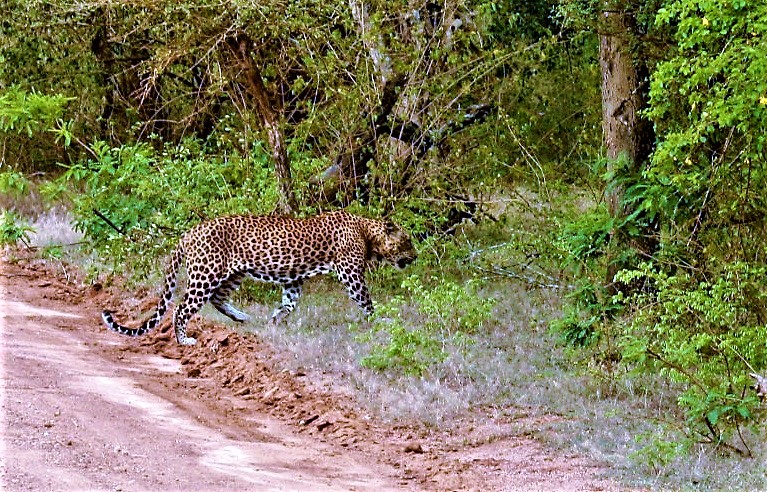
Yala National Park is famous for having one of the highest leopard densities in the world.
However, sightings are never guaranteed.
The best chance to spot one is during the dry season between February and June, and early mornings or late afternoon when the temperatures are cooler.
We were lucky; we spent most of the day searching for one before finally seeing it cross the track in front of us.
Although we did see a few relaxing in a distant tree. It was only noticeable with our zoom lens on our camera.
The key thing to remember is patience, and that unpredictability is part of the experience.

Sloth bears
Sightings of sloth bears are rare, but if you are lucky, you may see one or two foraging for fruit.
We didn’t see one, and we spent the whole day searching.
Don’t be disappointed if you don’t spot a bear.
Crocodiles
Some crocodiles were almost impossible to spot at first, blending perfectly into the muddy banks beside the waterholes.
Sri Lankan elephants
Everywhere you go within Yala National Park, there will be an elephant or a few grazing in open fields or splashing in nearby water sources.
We love elephants, and while they are beautiful up close, you should stay a safe distance away, as you don’t want to scare them or even make them angry.
Deer
There is a high chance you’ll see a deer or a few on safari through Yala.


Birds
If you are a birdwatcher or love birds, then this is the place to see many different species.
Some birds live here year-round, while others are just passing through on migration.
We saw many different species of birds, from herons, pelicans and ducks, to eagles and many more.


Do’s and Don’ts for you to consider
Want to make sure you’re being a responsible visitor? Here’s how to keep wildlife happy and safe: Remember, it’s their home, not ours:
Do’s
- Stay quiet and respect the animals, as loud noises can disturb the wildlife.
- Follow the park rules and your guide’s instructions at all times.
- Always keep a safe distance from the animals. If your driver suggests getting closer, politely decline, never approach, provoke, or risk getting closer for a better photo. A good camera with a long lens will let you capture amazing shots from a safe distance.
- Leave no trace of your visit. Take any empty containers back out with you, and avoid removing anything from the park. Every part of the environment could be important to the wildlife.
- Be patient. While you should have a good chance of seeing most animals. We might have seen something that you don’t, or vice versa.


Don’ts
- Don’t feed the animals. Feeding or disturbing wildlife can disrupt their natural diet, lead them to scavenge from your jeep, and, in some cases, make them aggressive.
- Don’t hop out unless your driver says it’s safe. We had lunch by the river and chilled by the beach, safe enough, but always keep your eyes open.
- Don’t push the driver to go closer; it can stress the animals and sometimes make them aggressive. This should be a safe trip, not putting your or others’ lives at risk.
- Don’t ever buy items made from animal parts; doing so supports illegal wildlife trade.
Most of this is common sense, but it’s your job to stick to these guidelines; they keep both you and the wildlife safe.
FAQs About Visiting Yala National Park
It is 100% worth visiting if you’ve never been on safari before. That said, it is the popular National Park in Sri Lanka compared to the parks in the country. This is due to the high leopard population.
If you would prefer a quieter park, then check out these other National Parks in Sri Lanka.
No, you do need a registered guide or tracker to enter the park. Because without one, your experience will be so much different.
At the end of the day, a guide or tracker will be experienced, they’ll know the routes and where most of the animals are going to be, although it can be a little unpredictable, because they are animals after all.
They’ll also be able to share with you their knowledge of the animals and point them out.
A guide or tracker will be a worthwhile investment, trust us, we couldn’t do without ours.
Conclusion
Visiting Yala National Park is one of the most memorable wildlife experiences in Sri Lanka, but it should start with a good plan.
Choosing the right time to visit, booking a safari that suits your travel style, and knowing what to expect before your visit can help make the most of your time in the park.
Yala might be best known for its leopards, but it’s also the combination of diverse wildlife, beautiful landscapes and the excitement of exploring something different that turns this from an average trip to a memorable experience that’s worth adding to any Sri Lankan itinerary.
If you’re continuing your Sri Lanka travel planning, be sure to explore our other guides on where to stay, how to get around the island, and the best places to visit in Sri Lanka to help you plan the rest of your trip.
Have you already started planning your trip to Sri Lanka, or are you still deciding if Yala should be part of your itinerary?
Are you thinking about a private safari, or would you prefer a shared game drive to keep costs lower? What’s the one animal you’re hoping to see most?
We’d love to hear what stage you’re at with your planning. Share your thoughts and questions in our Facebook group so we can help you shape the best possible trip.
It’s a friendly spot where everyone can get honest advice, browse itineraries, and ask questions while exploring Sri Lanka.
Continue your travel planning with these useful posts:
- Best places to visit in Sri Lanka
- Sri Lanka travel guide
- How to get around Sri Lanka
- Best time to visit Sri Lanka
- How much does it cost to visit Sri Lanka
- Common travel mistakes and how to avoid them in Sri Lanka
- 10 Day Sri Lanka itinerary
- 2 Week Sri Lanka itinerary
- 7 Day Sri Lanka itinerary
- Best train journeys in Sri Lanka